Paper Tears is an installation of light, sound, choreography, and image conceived as a temporal device. At its core lies an archive of paper watermarks preserved at the Museu Molí Paperer of Capellades. From this collection, the artist has selected 15th-century watermarks — drawings visible only against light—which here open a passage between past and present, echoing a time marked by widespread violence and shared distress.
These watermarks emerge from a moment of historical transition, when Mediterranean trade declined, and Atlantic routes expanded, shaping early European modernity and colonial extractive systems. Regions such as Venice and Catalonia played key roles in this shift, which continues to shape our contemporary condition.
For the artist, watermarks act as lapsus. This notion runs through the work. Performers, dressed as contemporary jesters, freely and humorously interpret the watermarks while becoming entangled in their own despair. Their thoughts revolve around boycotts, exclusion, exhaustion, and universal violence.
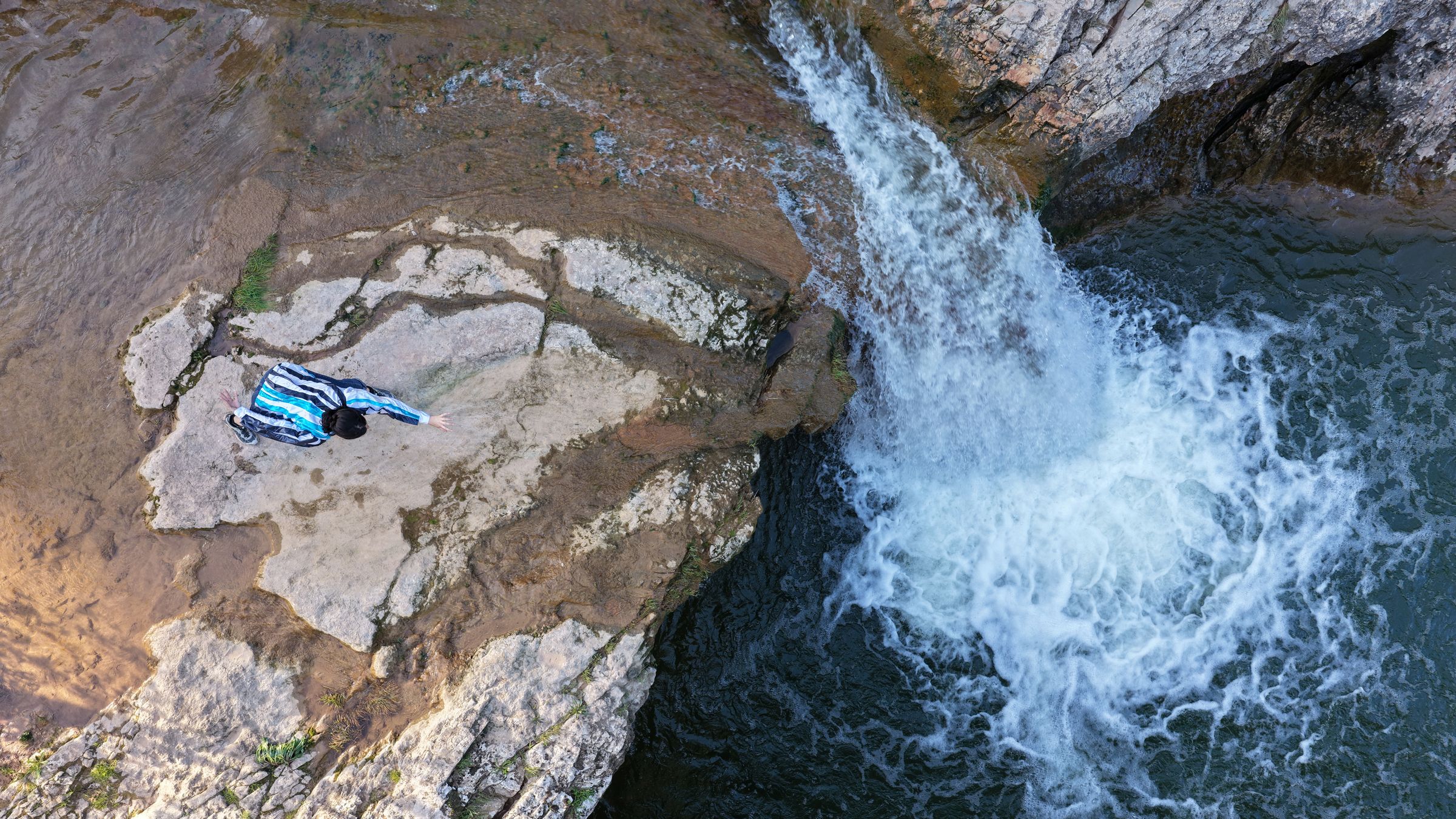
Structured like a waltz, the script makes watermarks, lapsus, and bodies repeat and return in shifting variations. The video, filmed at four springs from an aquifer that has provided water for paper production for centuries, links underground water flows to the hidden presence of watermarks. Shot with a drone from a zenithal view, the screen becomes a moving map and mirrors the water in circulation. The platforms surrounding the installation invite viewers to walk around, stop, and change their points of view.